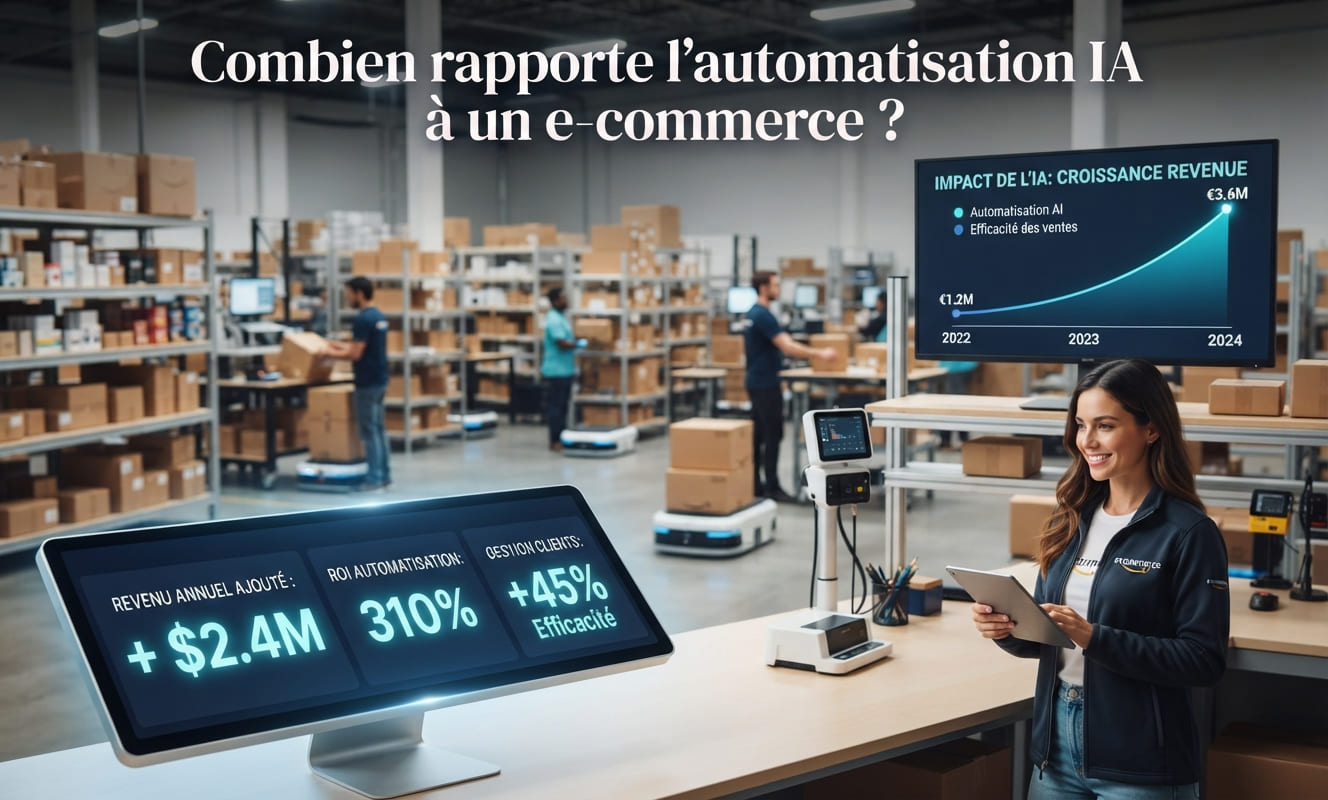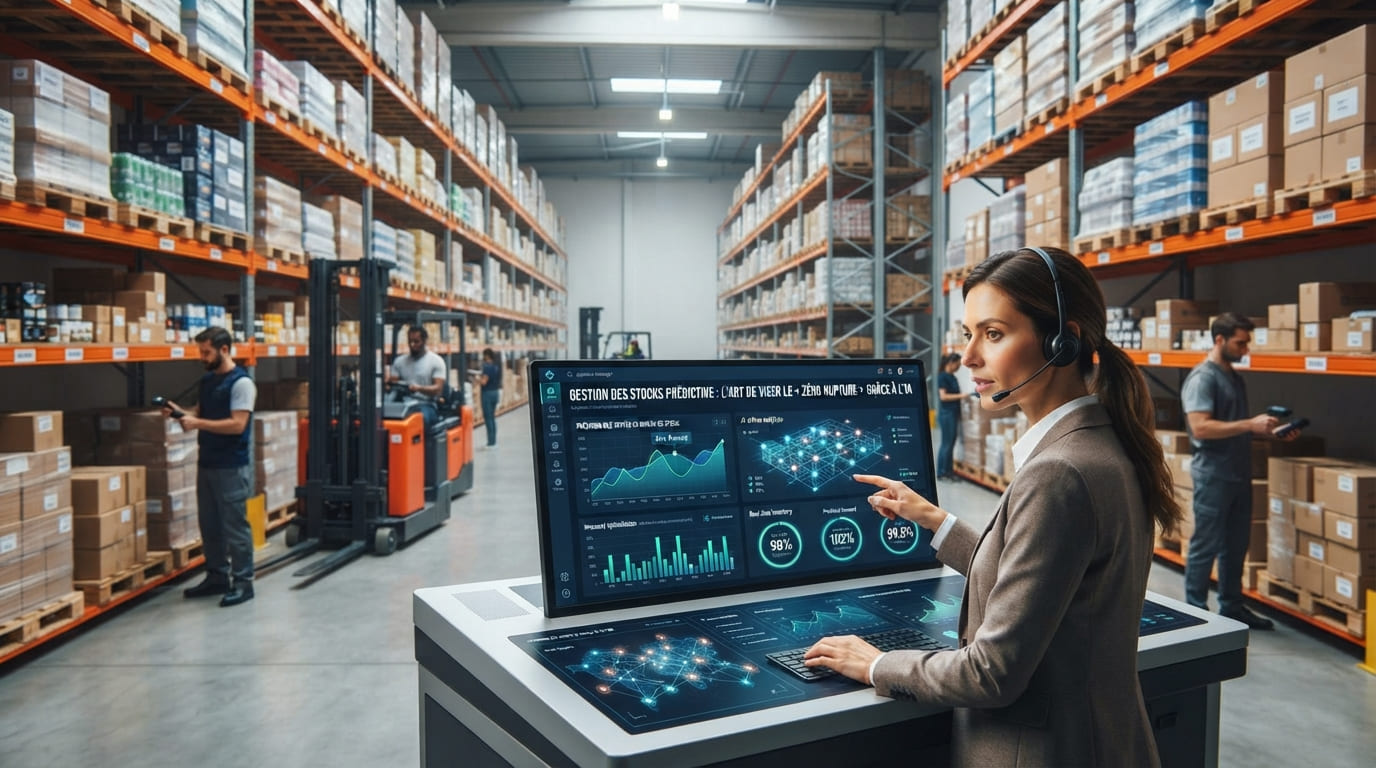
How to Automate Your E-commerce Store to Sell 24/7?
Maximize your revenue and save time by automating every step of your online business.

By connecting your current tools (e-commerce platform, CRM, logistics) to AI agents capable of answering product questions, handling common after-sales service (SAV) requests, and tracking orders without human intervention, at any hour of the day or night.
The dream of every e-commerce merchant? Seeing order notifications pop up on their phone, even in the middle of the night, without having to lift a finger. But for the majority of stores, the reality is different: the business often stops as soon as the team closes their eyes, creating an invisible but real revenue shortfall.
Thanks to technological advancements, automated online store management through AI is no longer a futuristic promise; it’s the standard for industry leaders. At Automate AI, this is one of the projects that comes up most frequently for our e-commerce clients as soon as they start selling internationally or see their traffic grow outside of traditional business hours. Here is how to automate your e-commerce store to sell 24/7 and transform your site into a selling machine available 24 hours a day, 7 days a week.
The Hidden Cost of a Store that "Sleeps"
Every hour your store is unable to answer a product question, handle a delivery issue, or clear up a doubt before purchase is an hour your conversion rate drops. The modern consumer expects an instant answer. If they have to wait until 9:00 AM the next morning to know if an item is in stock or how to process a return, they have likely already ordered from your competitor.
This cost is all the more insidious because it doesn't appear on any traditional dashboard: nobody spontaneously measures "the revenue lost between 10:00 PM and 8:00 AM," even though it is often one of the most significant sources of lost income for a rapidly growing store.
AI: Your Untiring Night Shift
Automation is not about replacing your teams but about freeing them from time constraints. By integrating AI agents, your store becomes capable of managing a massive workload without adding any staff:
Instant Answer to Product Questions: Your AI agent guides the visitor, recommends complementary items, and removes barriers to purchase, even at 3:00 AM.
Automatic After-Sales Service Dispute Resolution: A refund or exchange can be processed and validated automatically if the request meets your business rules, without human intervention.
Proactive Order Tracking: The customer is informed of their package status in real time, thus avoiding the thousands of repetitive tickets that usually flood your SAV on Monday mornings.
Increase Order Volume Without Increasing Costs
This is where automation becomes a major strategic lever. By delegating the handling of constant flows (tracking, information, simple returns) to an AI, your processing capacity becomes nearly unlimited.
You no longer need to hire new advisors to absorb a traffic spike or expand into new time zones. Your store handles the growth, processes requests, and finalizes sales seamlessly, day and night, including weekends and holidays.
Service Continuity as a Competitive Advantage
In an ultra-competitive market, reliability is what turns a casual visitor into a loyal customer. A store that "never closes" projects an image of professionalism and operational excellence. It is this feeling of security and responsiveness that directly influences the purchasing decision, especially for high-value products.
What Limits Should You Set for Nighttime Automation?
Going continuous doesn't mean automating everything without a safety net. Here are a few guardrails to plan for from the start:
A Value Threshold: Beyond a certain amount, a refund or exchange remains subject to human validation the next morning, rather than being processed automatically.
Detection of Atypical Cases: An unusual complaint, a clearly disgruntled tone, or a request outside the planned business rules should trigger a hold rather than a forced automated response.
A Daily Checkpoint: Every morning, review the decisions made by the AI during the night and adjust the rules if necessary.
How to Initiate Your Move to "Zero Interruption"?
You don't need to rebuild your site to start. Automation integrates progressively, connecting your current tools (CRM, ERP, e-commerce platforms) to a layer of artificial intelligence capable of making decisions. The implementation generally follows a step-by-step logic: first, answers to the most frequent product questions, then proactive order tracking, and finally, once trust is established, the automatic resolution of simple SAV cases.
If you wish to take this step and make your store a continuously operational entity, our e-commerce automation service supports you in implementing intelligent, connected, and autonomous management designed to grow your order volume without adding to your daily management burden.
In Summary
Online commerce never stops, so why should your store? Adopting automated online store management through AI means giving yourself the luxury of scalability and peace of mind. While you focus on your future projects, your store works, converts, and reassures your customers. Consult our e-commerce automation packages to find the formula suitable for your business volume.