E-commerce: How to Automate Customer Retention with AI ?
Maximize customer retention and Lifetime Value in your online store with automated AI workflows—no technical expertise required.
Retaining an existing customer is generally far less expensive than acquiring a new one. Yet, in most online stores, loyalty workflows remain basic: a birthday email, a monthly newsletter, or occasionally a discount code sent without any real logic. This is not due to a lack of effort, but because building personalized customer journeys previously required technical expertise or a dedicated agency budget.
AI-driven e-commerce automation changes this equation. Today, it allows you to design sophisticated loyalty scenarios, triggered automatically based on the actual behavior of each customer without writing a single line of code and without needing a dedicated tech team. Want to connect your customer data and launch your first workflows without starting from scratch? Our e-commerce automation service handles your customer data integration and configures these AI-driven retention workflows for you.
Why Does Manual Retention Quickly Reach Its Limits?
Managing customer loyalty "by hand" works as long as your customer base remains small. However, as volume grows, several structural issues emerge often without the marketing team realizing it immediately.
Identical Campaigns for All Customers
Whether they are new, repeat, or nearly inactive buyers, most customers receive the exact same message at the exact same time. A loyal customer of three years and a one-time buyer receive the same generic newsletter, even though their expectations are completely different.
Calendar-Based Triggers Instead of Behavioral Ones
A weekly newsletter sent on a fixed date completely ignores when the customer is actually receptive. A customer who just placed an order has different needs than someone who has been inactive for six months, yet both often receive the exact same communication.
Superficial Segmentation
Segmentation is too often limited to purchase history, ignoring recent engagement, browsing behavior, or early signs of churn. This static approach misses crucial re-engagement opportunities at the most relevant moments.
Significant Implementation Time for Every New Campaign
Designing, testing, and deploying a new loyalty sequence takes time, which discourages experimentation. As a result, workflows remain frozen for months or even years.
The cumulative outcome of these limitations is clear: high-value customers do not receive the attention they deserve, and at-risk customers are never re-engaged in time to be retained.
What Does AI E-commerce Automation Actually Enable for Loyalty?
Unlike traditional automation tools that require manually building every single rule ("if customer buys X, then send Y"), an AI-driven solution identifies relevant behavioral patterns on its own and continuously adjusts workflows without constant human intervention.
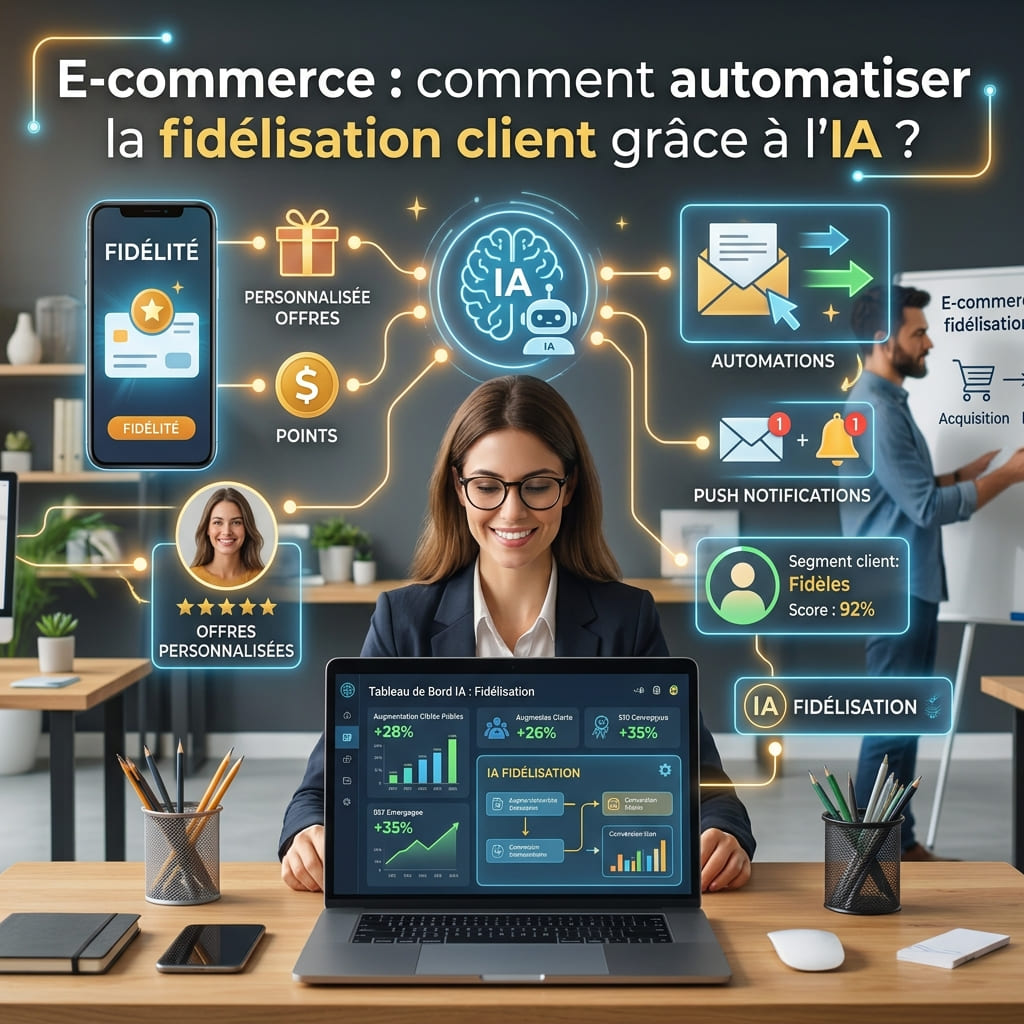
Dynamic and Evolving Segmentation: The AI categorizes customers based on real-time behavior—purchase frequency, average order value, viewed products, early signs of churn—and automatically updates these segments continuously without repetitive manual work.
Behavior-Triggered Scenarios, Not Calendar-Based: A customer who slows down their purchases receives a targeted re-engagement message before becoming inactive. A first-time buyer receives a welcome sequence tailored to their preferred product category, rather than a generic message identical for all new customers.
Personalized Recommendations at Every Stage: Instead of a generic product selection, the AI recommends items that are truly relevant to each profile based on browsing and purchase history, naturally increasing repeat purchases.
No Technical Skills Required to Create Scenarios: AI-powered automation platforms offer visual interfaces or natural language prompts to set goals, leaving the AI to handle trigger logic and long-term optimization. No coding is needed to launch, adjust, or stop a workflow.
What Is the Real Impact on Lifetime Value (LTV)?
The primary benefit of AI e-commerce automation is not measured merely in email open rates, but in its direct impact on the revenue generated by each customer over time.
Increased Repeat Purchase Frequency: Better-targeted re-engagement messages, delivered at the right moment, encourage repeat buys instead of a single purchase from a one-off customer.
Reduced Churn Rate: By detecting early warning signs of disengagement, AI allows you to step in before a customer becomes permanently inactive—at a point when re-engagement still has a genuine chance of succeeding.
Higher Average Order Value Over Time: Relevant recommendations and calibrated offers encourage cross-selling and upselling rather than blanket discounts that erode margins.
Reduced Manual Marketing Effort: Once goals are established, workflows run continuously and optimize automatically, freeing up the marketing team to focus on strategy rather than repetitive execution.
Why Is LTV a Better Metric Than Open Rate?
Many online stores still evaluate their retention campaigns through surface-level metrics: open rates and click-through rates. While useful, these metrics reveal nothing about the real impact on the total revenue generated by a customer throughout their relationship with your brand. AI-driven automation allows you to directly track LTV growth by segment, delivering a concrete financial ROI rather than a misleading vanity metric.
How to Set Up Retention Scenarios Without Coding
Implementing AI-driven automation typically follows a straightforward progression to maximize results from the very first weeks:
Connect customer and transactional data—purchase history, browsing behavior, email interactions—to the automation platform.
Define clear retention goals (reduce churn, increase purchase frequency, reactivate dormant customers) rather than manually configuring every single rule one by one.
Let the AI generate and test scenarios using visual drag-and-drop interfaces or natural language prompts instead of code.
Track LTV evolution and retention rates to validate the real business impact of the deployed workflows, segment by segment.
Gradually refine objectives as the AI deepens its understanding of customer behaviors and uncovers new growth levers.
Which Plan Should You Choose to Automate Customer Retention?
The right level of automation depends on the size of your customer database, your average purchase frequency, and the degree of personalization you wish to achieve. A store with a few hundred active customers does not have the same requirements as a brand managing tens of thousands of contacts.
Discover our e-commerce automation packages and find the right plan tailored to your customer base.
Should Customer Retention Still Rely on Generic Campaigns?
Customer loyalty should no longer rely on generic campaigns sent simultaneously to an entire mailing list. Thanks to AI e-commerce automation, it is now possible to build personalized workflows triggered by each customer's actual behavior—without technical skills and without constant manual effort.
The results are directly reflected in an increased Lifetime Value over time, rather than a short-lived boost from a single campaign—a far more accurate indicator of the true health of your customer relationships than any isolated open rate.