
How much does AI automation make for an e-commerce business?
How Much Does AI Automation Make for E-commerce?
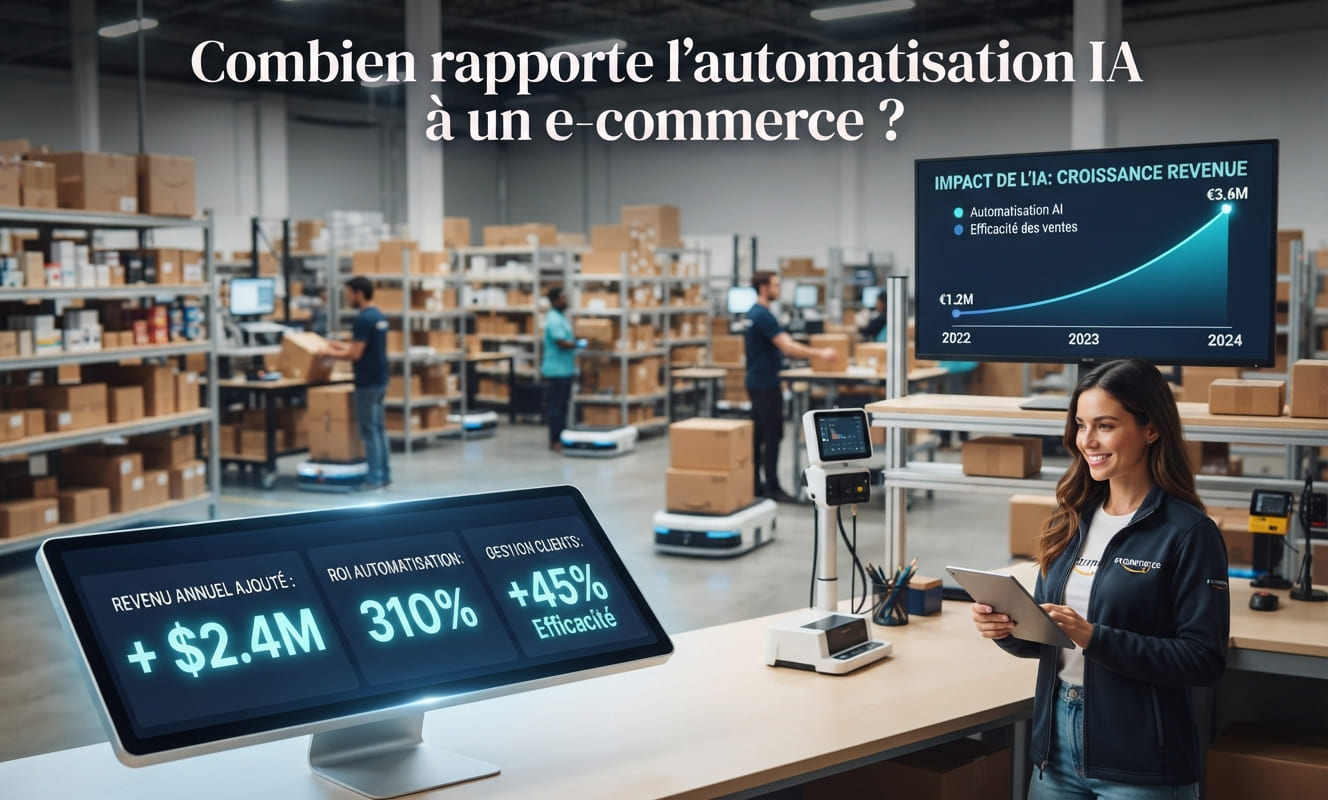
The answer to this question: "how much does AI automation make for an e-commerce business?" is simple: there is no universal or guaranteed figure. Your actual gains depend on your current conversion rate, average order value, and the quality of your customer service before automation. What we can give you, however, is the exact method to calculate your own potential and that is the purpose of this article.
Many e-commerce merchants view AI automation as just another tech expense. Yet, companies that have made the leap no longer talk about "costs," but about revenue growth. At Automate AI, this is systematically the first question we are asked before starting an e-commerce project: not "does it work," but "how much does it actually make, concretely, on my current turnover." The honest answer is: it depends on your starting point but we can show you how to calculate it.
The equation of lost (and recovered) revenue
To understand the impact, we must isolate three levers that AI activates simultaneously:
The conversion rate: AI removes purchase barriers by instantly answering prospect questions.
The retention rate: Responsive customer service builds lasting customer loyalty.
Operational efficiency: The time saved by your teams is reinvested in growth strategies.
The classic trap is to reason around only one of these three levers — most often customer service cost reduction, which is the easiest to visualize — while forgetting that conversion gains and retention generally weigh much heavier on net results.
An illustrative example to understand the calculation method
Important clarification: The amounts below are a pedagogical example built on reasonable hypotheses, not measured data from an actual store nor a performance guarantee. Available studies on the impact of AI chatbots show wide variations depending on sectors and methodologies some observe double-digit conversion gains on AI-assisted sessions, while others record more modest effects once averaged across total traffic. The only reliable figure for your business will be the one you measure yourself after deployment, via an A/B test or a pilot period.
Imagine a store generating 100,000 € in monthly revenue with a 2% conversion rate. To illustrate the method, let's assume a 0.3 percentage point increase in conversion thanks to instant assistance, a 50% reduction in customer service costs, and the recovery of a portion of sales lost to out-of-stock items and disputes:
Conversion
Mechanism: 2% → 2.3% (hypothetical)
Estimated impact: +15,000 €/month
Customer Service Costs
Mechanism: Costs cut in half (hypothetical)
Estimated impact: +2,000 €/month
Recovered Sales
Mechanism: Stockouts and disputes handled proactively (hypothetical)
Estimated impact: +4,500 €/month
Illustrative Total: +21,500 €/month
How to build your own estimate without guessed figures?
Measure your current conversion rate over the last 3 months, not an exceptional period.
Quantify your current customer service cost: time spent × loaded hourly cost of the team, over a typical month.
Estimate your lost sales from stockouts and disputes using your own inventory and claims data, rather than a generic percentage found online.
Test before generalizing: a pilot deployment on a traffic segment or limited timeframe provides real, highly reliable data compared to a theoretical simulation.
How is this revenue generated?
1. The radical reduction of cart abandonment rates
A customer asking a question about delivery or product compatibility who has to wait 12 hours for an answer is a lost customer. With AI e-commerce automation revenue gains, the agent responds in seconds, confirming the necessary information to validate payment immediately. It's the same principle we detail in our article on 24/7 online store management: every hour without an available response is an hour of lost conversion.
2. Conversational upsell and cross-sell
Unlike a basic chatbot, the AI agent knows the customer's history and needs. It can suggest a warranty extension, a complementary accessory, or an upgrade, turning every support interaction into an additional sales opportunity.
3. Recovering "at-risk" customers
When a customer expresses dissatisfaction, the AI detects the intent to churn. By automatically offering a customized solution (discount code, priority exchange), it turns a crisis situation into positive customer feedback and lasting loyalty.
The ROI of automation: an investment, not an expense
When you automate, you aren't replacing your teams: you are multiplying them. The Return on Investment (ROI) of AI is calculated over time:
Short term: Immediate savings on processing simple support tickets.
Medium term: Increased conversion rates through streamlined customer journeys.
Long term: Infinite scalability without needing to double headcount during growth spikes.
Mistakes to avoid in your own simulation
Not isolating the three levers separately: Adding up globally estimated gains without detailing conversion, costs, or recovered sales makes the final figure internally unconvincing.
Extrapolating an overly optimistic conversion point: A 0.3 point gain is a reasonable assumption for a first deployment; double-digit conversion promises should be challenged.
Forgetting implementation costs in net gain calculations: Training, integration, and human supervision during the first few months.
Disconnecting this figure from inventory management: A significant share of recovered sales depends on inventory reliability, a topic covered in our guide on predictive stock management.
Moving to action with a potential audit
Every store has untapped profit margins hidden within its current processes. Identifying where your losses lie whether in cart abandonment, support response times, or stock management is the first step toward boosting profitability.
If you want a customized simulation for your business, our e-commerce automation service helps you model your potential gains and deploy the tools needed to turn every interaction into profit.