How did IKEA transform its customer service using AI?
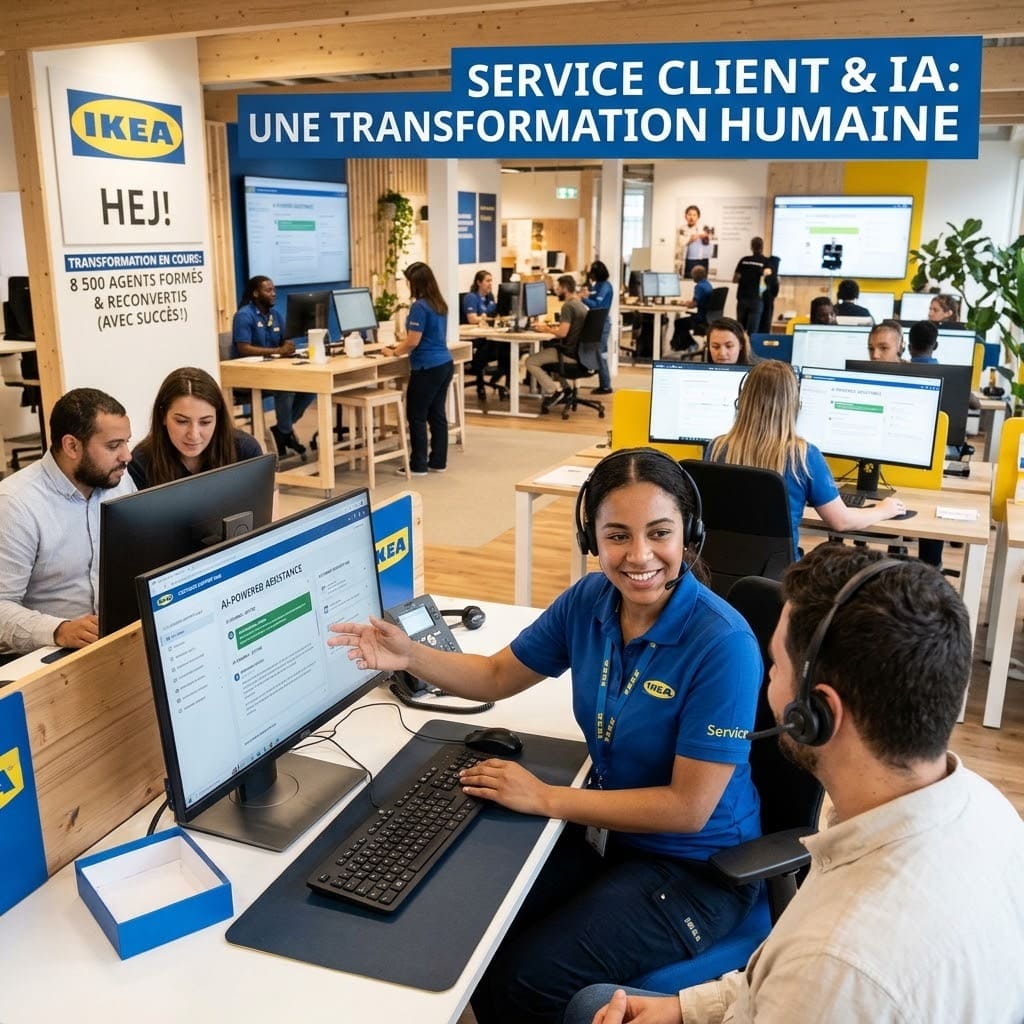
While tech and service giants like Salesforce, Uber, Verizon, and Oracle lay off thousands of contact center employees in the name of automation, IKEA is taking a unique path. By integrating advanced AI automation strategies to absorb repetitive incoming requests, the Swedish retailer made the strategic and social decision to reinvest in its human capital. Rather than downsizing its workforce to cut short-term costs, the company reskilled its employees into expert advisors, transforming a standard call center into a powerful engine for commercial growth.
1. Operational Strategy: From Operational Chatbot to Remote Sales
Since 2021, IKEA has deployed its virtual assistant named "Billie". Designed to handle first-level customer requests, the bot manages basic and recurring queries: order tracking, in-store stock availability, opening hours, and product return policies.
Massive Adoption by AI: Billie now absorbs 74% of routine queries, up from 47% two years ago, freeing up millions of hours of human labor.
8,500 Jobs Retained and Reskilled: Instead of initiating layoffs for partially automated positions, IKEA trained its agents to transition into high-value roles: remote sales advisors and interior design specialists (kitchen planning, wardrobe layouts, and complex space designs).
Structured Investment in Training: This transition was far more than a title change. It was backed by long-term HR support (nearly two years of gradual upskilling) as well as 5 to 6 weeks of intensive training on 3D modeling software and consultative sales techniques.
2. Remarkable Financial and Human Results
Performance metrics confirm the success of this human-centered automation strategy:
Revenue (Remote Sales)
Before: €1.08 billion
After: €1.25 billion (+15% to 20% annual growth)
Handling Volume by Billie Bot
Before: 47% of routine queries
After: 74% of routine queries
Satisfaction & Internal Engagement (eNPS)
Before: 60% favorable opinion
After: 89% favorable opinion
Role Evolution for Human Agents
Before: Assembly-line style customer complaint handling
After: Tailored interior design advisory and customer concierge service
Overall Financial Impact
Before: High logistics costs caused by input errors and standardized support
After: Incremental revenue generation and a sharp drop in costly returns (especially for kitchen planning)
3. Is the IKEA Model Replicable for Every Company?
While this strategy proved successful, it relies heavily on IKEA's specific business model.
A retail brand selling complex, modular physical goods finds a direct economic incentive in shifting its teams toward advisory roles: human interaction directly increases average order value.
Conversely, for companies operating on transactional services (ride-hailing platforms, telecom subscriptions, Level-1 IT support), customer service remains a structural cost center that is technically harder to evolve into a premium sales channel.
4. Two Future Paths for Work in the Agentic Era
The IKEA case highlights the true role of human workers in an era of autonomous AI agents. Two major transformation paths are emerging for the coming years:
Internal Upskilling (The IKEA Model)
When customer relationships directly influence buying decisions, AI takes care of volume and repetition. Humans then focus on empathy, managing complex scenarios, and tailored advisory services. The call center agent role evolves into an expert or concierge function.
External Reskilling Toward Essential Social Roles
For organizations where customer support lacks sales potential, career transitions must be planned at a societal and regional level. The interpersonal skills developed by support agents (active listening, conflict resolution) serve as a valuable talent pool for sectors facing demographic or labor shortages:
In-Home Care and Senior Support: Assisting elderly populations and supporting families represent massive, non-automatable needs.
Civic Engagement and Emergency Services: Public safety and emergency response roles (such as volunteer firefighting) face a continuous need to reinforce their workforces.
Short Qualification Pathways: These fields rely on targeted certifications lasting just a few months, offering practical and rapidly deployable career shifts.
Conclusion
By delegating 74% of queries to its virtual assistant to reinvest in reskilling its 8,500 employees, IKEA proves that artificial intelligence does not inevitably mean workforce reduction. When implemented strategically, automation frees human potential from repetitive tasks to redeploy it where empathy, guidance, and expertise deliver true added value.