Category: E-commerce
Tags: AI agent, ecommerce automation, inventory management, supply chain, artificial intelligence
Beyond the Chatbot: How Autonomous AI Agents Are Transforming E-Commerce Stock & Supply Chain Management ?
From Reactivity to Prediction: AI at the Heart of Goods Flow
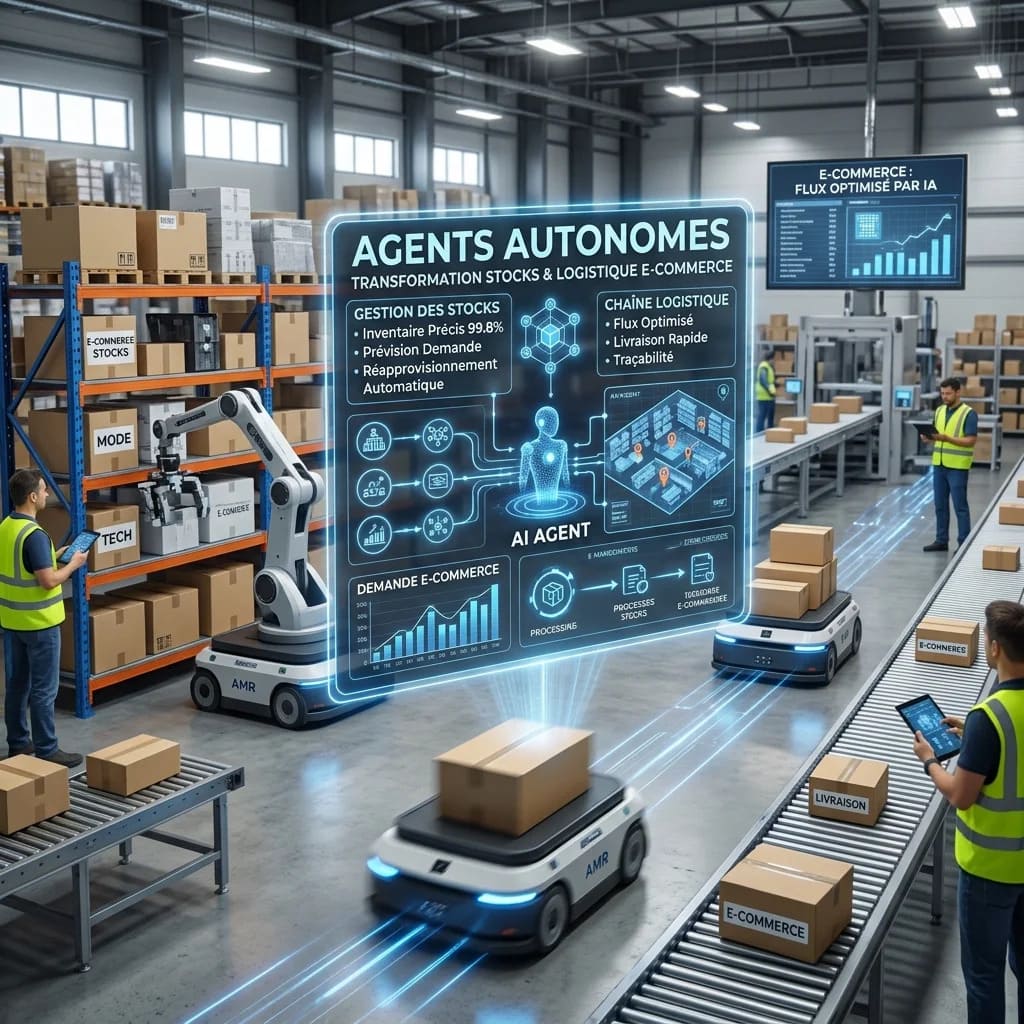
In today's e-commerce landscape, artificial intelligence is often reduced to its simplest form: a text assistant or customer support chatbot tasked with answering repetitive questions. However, a silent revolution is underway. Forward-thinking companies are no longer just chatting with their customers, they are automating their core operational processes end-to-end using autonomous AI agents connected to their technical ecosystems.
When addressing supply chain and inventory management, the bottlenecks are all too familiar: unexpected stockouts, overstocking that ties up cash flow, shipping delays, and manual data re-entry across online stores, management systems, and invoicing software.
Through tailored e-commerce automation solutions, integrating intelligent agents and automated workflows is rewriting the rules of inventory management.
1. From Reactivity to Prediction: AI at the Heart of Goods Flow
Traditionally, inventory managers react only after a critical stock threshold is breached. AI agents radically shift this paradigm by acting proactively through predictive analytics.
By cross-referencing real-time traffic data, seasonal sales history, advertising campaign performance, and supplier restocking lead times, a custom AI engine can:
Anticipate demand spikes for specific product SKUs long before they impact warehouse shelves.
Trigger automatic purchase orders with suppliers whenever predictive inventory parameters require it, accounting for transit lead times.
Dynamically adjust product display on your storefront to prevent customer frustration and order cancellations.
2. Data Flow Orchestration Without Human Intervention
One of the biggest productivity killers in e-commerce is tool fragmentation. Inventory updates on your e-commerce CMS, financial records move to your business accounting software, carriers update tracking codes, and customer service handles inquiries via email or the WhatsApp API.
AI agents act as an invisible conductor connecting these software building blocks:
Instant Omnichannel Synchronization: The moment a sale is confirmed on any channel, inventory levels immediately reflect across all physical and virtual warehouses.
Automated Delivery Dispute Management: If a carrier reports a delay or lost package, the AI agent cross-references inventory data, arranges a replacement shipment, or automatically updates the customer—without requiring manual intervention from a human operator.
3. Freeing Up Human Capital for Strategy
The most powerful secondary benefit of process automation is its impact on internal teams. By handing over time-consuming inventory reconciliations, delivery note tracking, and stock movement logs to 24/7 autonomous agents, e-commerce managers recover their most valuable asset: time.
Instead of spending hours putting out operational fires (or manually coordinating schedules and check-ins, much like the hospitality challenges solved by booking automation), teams can refocus on acquisition strategies, high-value supplier negotiations, and elevating the overall customer experience.
Towards Fully Autonomous Logistics
E-commerce AI has crossed a decisive threshold. It is no longer just about driving traffic or writing product descriptions; it is about restructuring your company's operational backbone.
Deploying AI agents capable of making logical decisions, qualifying complex workflows, and executing background tasks gives your business the agility and resilience needed to outpace competition in a highly demanding market.