
How to secure your automated accounting data against GDPR?
Practical guide to balancing accounting automation with GDPR compliance.
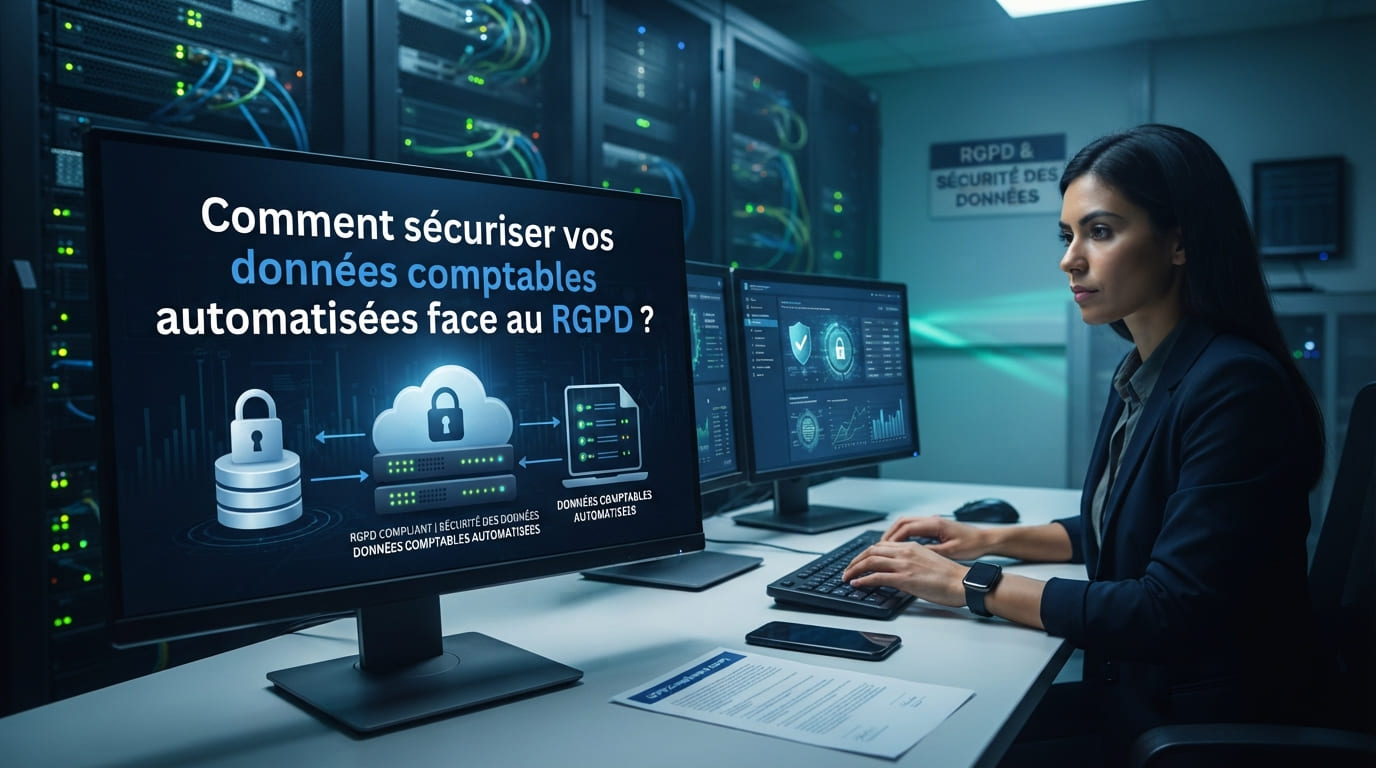
In the era of digital transformation, financial management can no longer be conceived without digital tools. However, as soon as a company or firm deploys the Cloud, APIs, or Artificial Intelligence to accelerate its processes, a major issue arises: How to secure your automated accounting data against GDPR?
With automation, the volumes of financial data processed increase exponentially, access points multiply, and information governance can no longer be a simple option. Invoices, bank details, and pay slips constitute priority targets for cybercriminals. To transform this regulatory obligation into a true pledge of trust, compliance must now be thought of "by design", meaning integrated from the very conception of your digital ecosystem.
1. Why does cyber risk change scale with automation?
Accounting databases harbor a wealth of critical information that goes far beyond the simple scope of turnover. They contain the complete identity of your clients, the bank details (IBAN, BIC) of your partners, your employees' salary scales, and the history of your cash flows.
In an interconnected and automated environment, danger is not limited to a simple data breach. The risk also includes:
Unauthorized internal access: A lack of rights compartmentalization allows employees to view ultra-sensitive documents (such as payslips).
Ransomware attacks: The blocking of your automation tools can instantly paralyze your entire billing chain.
API misconfiguration: Poorly secured gateways between your accounting software and third-party applications can create entry points for hackers.
For an accounting firm or financial management, the major challenge is therefore to combine algorithmic productivity with strict access control, without ever sacrificing third-party confidentiality.
The expert's advice: Do you refuse to choose between operational performance and digital sovereignty? Discover our highly secure automated accounting solutions to protect your most precious assets.
2. The 3 technical pillars of a compliant infrastructure
To concretely meet the compliance objective, your IT architecture must deploy several interconnected defense layers:
A. End-to-end encryption
Your documents and flow data must be made completely illegible to unauthorized third parties. Serious automation solutions apply strong encryption at two levels: at rest (when data is stored on servers) and in transit (during data exchanges between your different tools via HTTPS protocols).
B. Strong authentication (MFA)
A simple password is no longer enough to protect accounting access. Implementing multi-factor authentication (MFA) is essential to block account hijacking attempts by requiring systematic dual validation (via a smartphone or security key) upon every connection.
C. Fine-grained privilege management
Not all employees need access to all company data. Automation allows rights to be segmented by applying the principle of "least privilege": an assistant will only have access to entering supplier invoices, while strategic data will remain reserved for the CFO or the chartered accountant.
3. Contractual and human obligations not to be overlooked
Knowing how to secure your automated accounting data against GDPR also means looking beyond technology. The regulation imposes strict liability (accountability) that extends to your partners and teams.
Subcontractor auditing: Automation software publishers have the status of processors under the GDPR. Their contracts must include strict legal clauses on the protection of transferred data and guarantee hosting on compliant servers (ideally sovereign and located within the European Union).
Total traceability: Your system must generate indestructible event logs to know at any time who accessed a document, when, and from which workstation.
Team awareness: Human error remains the major cause of security incidents. Training your accountants in phishing detection and password management is a legal security obligation.
Conclusion
The security of your financial bases should not be perceived as a brake on innovation, but as the essential condition for deriving lasting gains from Artificial Intelligence. The more your organization automates its processes, the clearer, more rigorous, and more documented your data governance must be.
Ready to secure the digital future of your structure? Explore our compliant accounting automation packages now and discover the offer perfectly tailored to your confidentiality requirements.